ILQGS
ISLQG
Anzhong Wang and Tao Zhu
29 Jun 2026
Report from the Loops '26 International Conference on Quantum Gravity in Hangzhou (China)
The Loops '26 International Conference on Quantum Gravity was held from 24 to 29 May 2026 in Hangzhou, China. The conference brought together more than 160 participants from over 40 universities and research institutions worldwide. It was organized by the School of Physics and Optical Engineering at Zhejiang University of Technology (ZJUT). As the latest instalment in the Loops series, the conference provided a forum for researchers working on loop quantum gravity (LQG), its applications to cosmology and black hole physics, and related topics. The year 2026 marked the 40th anniversary of loop quantum gravity (1986–2026). Loops '26 thus served not only as a venue for presenting new results but also as a celebration of four decades of progress in the field.
The conference took place at the Huabei Hotel in Hangzhou, situated by the scenic West Lake. The Local Organizing Committee was chaired by Prof. Tao Zhu (ZJUT), with Profs. Bao-fei Li and Qiang Wu serving as co-chairs. The Scientific Advisory Committee was co-chaired by Prof. Ronggen Cai (Ningbo University) and Prof. Anzhong Wang (Baylor University).

The conference officially opened on the morning of 25 May with a brief ceremony chaired by Prof. Tao Zhu. Prof. Wang Jianguo, Vice President of ZJUT, and Prof. Wang Xiaolong, Dean of the School of Physics and Optical Engineering, delivered welcome speeches on behalf of the university. Prof. Hanno Sahlmann (University of Erlangen-Nürnberg), speaking on behalf of the International Society for Loop Quantum Gravity, expressed gratitude to the local organizers and encouraged participants to engage in active exchange of ideas. Prof. Chen Bin (Ningbo University), Chair of the Gravitation and Relativistic Astrophysics Division of the Chinese Physical Society, also welcomed the attendees and emphasized the importance of international collaboration in quantum gravity research. Immediately following the opening remarks, all participants gathered for a group photo to commemorate the 40th anniversary of LQG.


The scientific program spanned five full days (25–29 May) and comprised morning plenary (invited) talks, afternoon parallel sessions, panel discussions, and a young researchers' working group meeting.
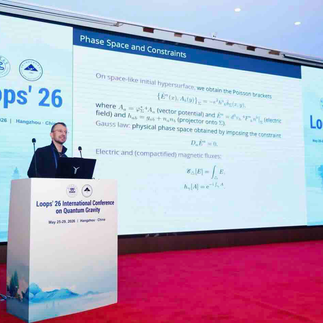
Plenary talks were delivered by invited speakers and covered a broad range of topics, from fundamental theory and mathematical structures to applications in black holes, cosmology, and quantum information. According to the conference handbook, a total of 20 invited plenary lectures were presented. Speakers included (in order of presentation): Abhay Ashtekar, Carlo Rovelli, Yue-Liang Wu, Yongge Ma, Hanno Sahlmann, Kristina Giesel, Bianca Dittrich, Xiaodong Zhang, Ivan Agullo, Francesca Vidotto, Eugenio Bianchi, Hongguang Liu, Alejandro Perez, Bao-fei Li, Guillermo Mena Marugan, Muxin Han, Wolfgang Wieland, Qiaoyin Pan, Astrid Eichhorn, and Luca Marchetti.
Parallel sessions were held on three afternoons (25, 26, and 28 May), with two concurrent streams each day. The sessions were organized into six thematic topics: (1) Canonical Loop Quantum Gravity; (2) Covariant Loop Quantum Gravity /Spinfoam Theory; (3) Black Hole Physics; (4) Quantum Cosmology; (5) Boundaries, Symmetries, and Quantum Foundations; and (6) Black Holes and Cosmology. Each parallel stream featured 6 to 8 contributed talks of 15 minutes each. In total, the program included nearly 80 oral presentations, covering new developments in Hamiltonian and path-integral methods, effective models, numerical simulations, black-hole spectra, cosmological perturbations, bounce models, group field theory, and quantum reference frames.


The program also featured five panel discussions: (1) Canonical LQG/Beyond Panel (chaired by Hanno Sahlmann); (2) Spin Foam Panel (chaired by Hal Haggard); (3) LQC Panel (chaired by Parampreet Singh); (4) LQBH Panel (chaired by Kristina Giesel); and one Young Researchers Working Group (YRWG) session (chaired by Hongguang Liu). These panels offered researchers a valuable opportunity to discuss open questions, compare different approaches, and explore future directions. The YRWG session was particularly well-received among postdocs and graduate students, fostering meaningful interactions among younger researchers.
The scientific program concluded on the afternoon of 29 May with a summary talk by Prof. Abhay Ashtekar, who reviewed the main results presented at the conference and highlighted remaining challenges. Closing remarks were delivered by Prof. Hanno Sahlmann.




Several social and outreach activities were organized alongside the scientific program: A banquet was held with the theme "Celebrating LQG: 40 Years (1986–2026)."
Prof. Daniele Oriti announced the recipient of the inaugural Ashtekar Award, which was presented to Dr. Wolfgang Wieland, who delivered a brief and remarkable acceptance speech. This award, established with the generous support of MDPI AG on behalf of its journal Universe, is intended for young researchers holding faculty positions in the field of LQG. Starting this year, the award will be presented at each Loops conference.
To commemorate the 40th anniversary of LQG, a representative from Universe also presented a plaque to Prof. Abhay Ashtekar in recognition of his pioneering work on LQG, published in 1986.
Prof. Hanno Sahlmann announced the creation of the Lewandowski Award. The first award will be given at Loops'28.
Prof. Beatriz Elizaga Navascues announced that the next Loops conference (Loops'28) will be hosted by her university in Spain.
Prof. Carlo Rovelli delivered a public lecture titled "Quantum Gravity, Black Holes and Dark Matter" at the Cricket Hall of ZJUT. The lecture attracted a large audience of students and faculty, generating significant interest among non-specialists.

Prof. Hanno Sahlmann announced the winners of the Ashtekar Prizes, which were awarded to Dr. Seth Asante and Mr. Changkai Chen for their excellent research and oral presentations. These prizes, established alongside the Ashtekar Award for postdoctoral fellows and students, are also supported by MDPI AG on behalf of Universe. Starting this year, they will be presented at each Loops conference.
Loops '26 concluded successfully, with strong participation from the international loop quantum gravity community. The conference provided an excellent platform for sharing the latest advances in canonical and covariant LQG, black-hole physics, quantum cosmology, and related fields. The 40th-anniversary celebration, the public lecture, and the social events fostered collaboration and inspired young researchers. We extend our sincere gratitude to all participants, speakers, and the local organizing team for making this meeting a memorable and productive event.
—Anzhong Wang and Tao Zhu on behalf of the Loops'26 Organizing Committees reporting.